
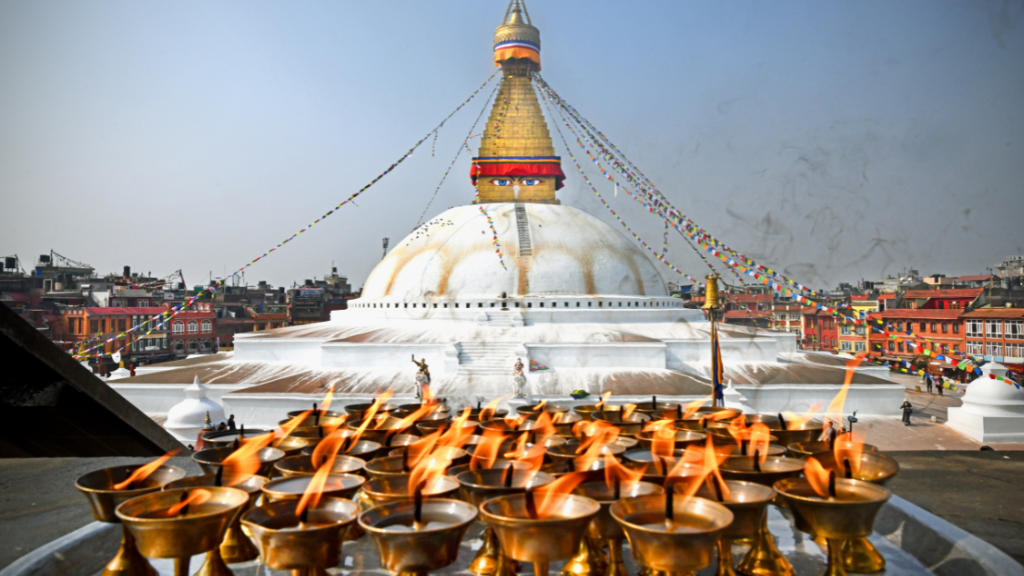
A tour to Lumbini is a peaceful and spiritual experience. Located in the southern plains of Nepal, Lumbini is one of the most important pilgrimage destinations for Buddhists around the world. It is the sacred place where Siddhartha Gautama, later known as the Buddha, was born more than 2,500 years ago.
Today, Lumbini attracts visitors from all over the world who come to explore its monasteries, temples, and historical landmarks. The calm environment and beautiful gardens make it an ideal place for meditation, cultural exploration, and spiritual reflection.
About Lumbini
Lumbini is recognized as a UNESCO World Heritage Site because of its historical and religious importance. The area contains many sacred sites, archaeological remains, and monasteries built by Buddhist communities from different countries.
The most important site in Lumbini is the Maya Devi Temple, which marks the exact place where Buddha was born. Inside the temple, visitors can see ancient ruins and the sacred marker stone that identifies the birthplace.
Next to the temple is the Ashoka Pillar, built by the Indian emperor Ashoka in 249 BC to commemorate his visit to Lumbini.
Another sacred spot is the Puskarini Pond, where Queen Maya Devi is believed to have bathed before giving birth to Buddha.
Monasteries and International Monastic Zone
Lumbini is home to many beautiful monasteries built by different Buddhist countries including Thailand, Myanmar, China, Japan, Germany, and France. Each monastery reflects the unique architecture and traditions of its country.
Walking through the International Monastic Zone allows visitors to experience different styles of Buddhist art, culture, and spiritual practice in one place.
Many visitors enjoy quiet walks or meditation in the peaceful gardens surrounding the monasteries.
Best Time to Visit Lumbini
Lumbini can be visited throughout the year, but the best seasons are:
October to March
Pleasant weather and comfortable temperatures make it the best time to explore the area.
April to June
The weather becomes warmer, but mornings and evenings are still good for sightseeing.
July to September
Monsoon season brings rain, but the gardens and landscapes become very green and beautiful.
Lumbini Tour Itinerary (2 Days / 1 Night)
Below is a simple itinerary for exploring Lumbini.
Day 1: Travel to Lumbini and Explore Sacred Sites
In the morning, travel from Kathmandu or Pokhara to Lumbini by tourist bus, private vehicle, or domestic flight to Bhairahawa.
After arriving and checking in to your hotel, begin your tour of the sacred area.
Afternoon Activities
- Visit the Maya Devi Temple
- See the Ashoka Pillar
- Walk around the peaceful Puskarini Pond
Evening
- Visit several monasteries in the International Monastic Zone
- Enjoy a peaceful sunset in the garden area
Overnight stay in Lumbini.
Day 2: Monastery Visit and Departure
After breakfast, continue exploring the monasteries built by different countries in the International Monastic Zone.
Visitors can observe meditation areas, beautiful Buddhist architecture, and peaceful gardens.
After completing the tour, return to Kathmandu, Pokhara, or continue your journey to other destinations in Nepal.
Your spiritual journey to the birthplace of Buddha comes to an end.
Trip Highlights
- Visit the birthplace of Siddhartha Gautama (Buddha)
- Explore the sacred Maya Devi Temple and Ashoka Pillar
- Walk through the peaceful Lumbini Garden
- Discover beautiful monasteries built by different countries
- Experience a calm and spiritual atmosphere
Drive from Kathmandu (1350m.) to Dolakha (1660m.) via Lamosangu (750m.) and Charikot (1980m.) by bus Rest and relax at the camp.
Today, from Dolakha we trek along the west bank of the Tama Koshi and reach Chetchet where we enjoy a view of an attractive waterfall. We continue moving downward for an hour or more, and we again climb mounting to the village of Simigaon. Then we make a gentle walk up to the lodge. From this village, we could see Mt.Gaurishanker more clearly.
On the way from Simi Gaun, you come across the Sherpa villages. The ascending trek is rich in diverse varieties of plants and Rhododendron trees. Following the uphill trek, you will now come across ascending and descending paths while enjoying the picturesque beauty of the place. If it happens to be a season, you will witness the Yak Naka a temporary Yak shed especially for the preparation of cheese and butter.
From Daldung La, the trek now goes up through different varieties of plants and Rhododendron trees. You trek over the suspension bridges over the deep gorges in few places making the trek even more enchanting. You finally reach Bedding which is a big Sherpa village.
We have a rest day today for acclimatization and have panoramic views of mountains like Mt. Gauri Shanker, Tibetan mountains of the Tibetan border.
On the way to Na from Bedding, we will see terrain full of the extraordinary scenery of the surrounding high landscapes, and the snow-capped peaks. We need to stroll to accustom ourselves all the way up to Na Gaun. From this village, we can view the beautiful summit of Chobutse 6,689m rises above the Tsho Rolpa Lake and Trakarding glaciers.
Today, after a long trek you may have a full day's rest at your camp. In the daytime, you can travel around the local areas. At night you will be entertained by a dance party in the Camp with Nepalese folk songs. Rest and relax at the camp.
From Na, the trek goes up high glacier walk with the land enhanced with white ice all over with crampons and ice sacks. You will be staying overnight in the Yalung Glacier high camp.
You keep on ascending until you reach Yalung Danda, and then you trek steep incline up to the path to Base Camp. The way you pass through is by the rocky glacier. You will be able to observe an assortment of views of mountains like Gauri Shanker, Menlung, Yalung, and the mountains of Tibet.
Early morning climb the Ramdung peak 5,930m with your climbing guide, from the peak you can have scenic views of Gauri Shankar, Menlung, Yalung, Pigphero go sharp peak, Number Himal, Yalung peak and the mountains of Tibet. After summiting the peak back to Yalung base camp.
Today, we descend back to Na; you will be able to get pleasure from the scenic beauty of the environment.
After trekking at a high altitude, you will have a rest day today. You will be preparing for the trek to Tso Rolpa Lakeside as an optional visit.
You will be trekking through the flat and progressively up the path. You will be able to observe the beautiful natural lake filled with the chilling water of the glaciers.
Early morning you will hike through the glaciers all the way through the day and will be able to experience the new captivating beauties that would add extra dimensions to your trial.
The trail will still be moving up through some rock climbing and a steady walk on the glacier. You will camp at Tashi Lapcha Pedi Camp today.
You will climb up the Tashi Lapcha Pedi and cross the Tashi Lapcha Pass through Tashi Cape. The completely will be entirely over the snow straight up and then steep down towards Tashi Cape.
Today you will be experiencing a bit of easy glacier walking. The trail descends towards Thyomgbo.
Early morning you will ascend to Thame. This trail steadily descends and you will have an added experience of a more natural path and will be able to enjoy the natural beauty of the environment.
From Pheriche, we take a slightly different route down to Orsho, then moving to Pangboche village. Here we can see the oldest monastery in the region which contains what is said to be the scalp and bones of a 'Yeti' or the abominable snowman. Leave mountains behind us, and our descent takes us through Tengboche Monastery at the elevation of 3860 meters before continuing back to the town of Namche Bazaar at 3441meters. We arrive back at Namche Bazaar in the afternoon.
After having our Breakfast, go back over the main track down to Dudh Koshi retracing to Phakding. Following the trail, we reach Lukla scaling different Sherpa villages crossing a suspension bridge above Thado Kosh. For about 45 minutes, we climb to accomplish the entire trek, and we reconfirm flight tickets and see off to local porters.
After traveling for 35 minutes, we fly back to Kathmandu,